Meta’s New AI System, Brain2Qwerty v2 Decodes Brain Signals into Text
In Focus
- Brain2Qwerty v2 uses magnetoencephalography to capture brain signals
- Magnetoencephalography relies on external sensors
- Meta’s thoughts-to-text AI model reconstructs complete sentences in real time
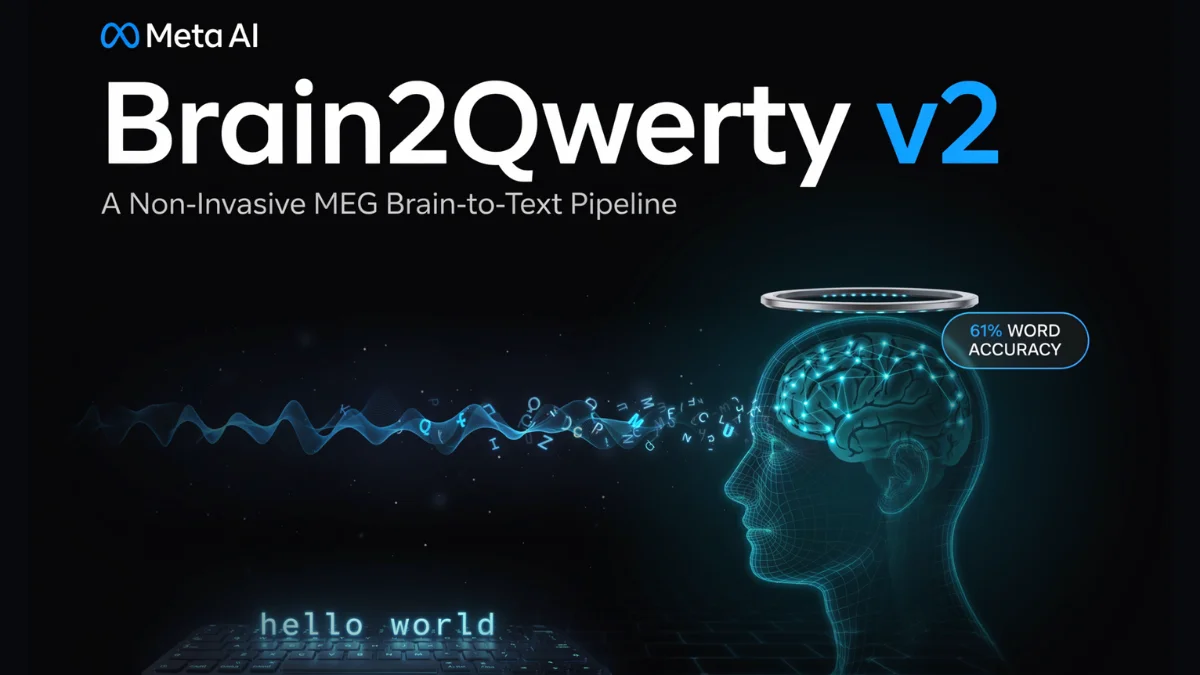
Meta has introduced Brain2Qwerty v2, an AI system that can translate brain activity into text without the need for a surgical implant. The social media giant said Brain2Qwerty v2 is the best-performing system for decoding sentences in real time from non-invasive brain signals. Meta’s thoughts-to-text AI system represents a significant milestone in brain-computer interface research.
How Meta’s Thought-to-Text Technology Works
Brain2Qwerty AI model uses magnetoencephalography (MEG) to capture the tiny magnetic fields produced by brain activity as a person thinks about what they want to say. Unlike invasive brain-computer interfaces that rely on electrodes in brain implants, MEG uses external sensors placed around the head.
Meta’s mind-reading system then processes the brain signals through an end-to-end AI model that decodes them into text. The system reconstructs complete sentences in real time. This approach makes the process of translating brain activity to text completely non-invasive.
“We trained Brain2Qwerty v2 on approximately 22,000 sentences from nine volunteer participants, each recorded for 10 hours wearing a magnetoencephalography (MEG) device while actively typing. Instead of relying on hand-crafted pipelines to detect neural events, we use end-to-end deep learning to decode directly from raw brain signals,” Meta said in a statement published on its website.
Meta unveiled its thoughts-to-text AI months after its Superintelligence Lab launched the Muse Spark AI model. The multi-agentic model generates responses to health questions for users.
How Meta’s Brain-to-Text AI Turns Brain Signals into Text
Brain2Qwerty v2 combines large language models trained on neural data with AI-powered decoding techniques to turn brain signals into coherent text. The language models use semantic context to improve sentence reconstruction.
The tech giant uses AI agents to optimize the decoding process before engineers select the final training configuration. Meta’s thoughts-to-text AI system appears to be nearing the accuracy of brain-to-text systems that rely on surgically implanted electrodes.
“Brain2Qwerty v2 recovers sentences coherently from noisy neural inputs, achieving a word accuracy rate of 61%, significantly improving upon the 8% word accuracy from other non-invasive methods,” Meta noted in its statement
The company added that for the best-performing participant, the system reached a word accuracy rate of 78%, with over 50% of the decoded sentences containing one word error or fewer.
What does Brain2Qwerty v2 Mean for Meta?
Meta’s brain-to-text AI is still in the experiment stage. If successful, the technology could help people who lose the ability to speak after traumatic injury, stroke, or neurological disease to communicate using their thoughts.
Brain2Qwerty v2 strengthens Meta’s position in the race to develop advanced AI and brain-computer interface technologies. The new thoughts-to-text AI model highlights Meta’s ambition to expand beyond generative AI to compete with companies like Elon Musk’s Neuralink, which develops implantable brain-computer interfaces (BCIs).
As tech companies race to build advanced AI systems, Meta appears to focus more on technologies that unlock new ways for humans to interact with computers.