
Introduction
As the global entertainment sector progresses through 2026, the streaming industry has shifted from a phase of aggressive, debt-fueled subscriber acquisition to an era defined by profitability, advertising integration, and structural consolidation. For consumers and market analysts evaluating the landscape, the central comparison frequently reduces to the two foundational pillars of modern streaming: Netflix and Hulu.
Both platforms promise comprehensive entertainment ecosystems, but their operational strategies are fundamentally distinct. Determining which platform delivers superior value in day-to-day entertainment consumption requires evaluating their underlying business models, content delivery strategies, and pricing structures. This analysis bypasses the marketing narratives to examine how Netflix and Hulu operate in the current market.
Executive Summary: Core Differences at a Glance
- Business Model & Scale: Netflix operates as a high-volume, global Subscription Video on Demand (SVOD) and advertising platform. Hulu operates exclusively within the United States, functioning as a hybrid SVOD, advertising, and live Virtual Multichannel Video Programming Distributor (vMVPD).
- Pricing Model: Netflix utilizes tiered pricing based on resolution, concurrent streams, and ad inclusion. Hulu offers a lower base ad-supported entry point, aggressive bundling within the Walt Disney Company ecosystem, and a premium live television tier.
- Best-Fit Case for Netflix: Consumers and households prioritizing an immense, frequently updated library of exclusive global original content, ad-free binge-watching, and emerging live sports/events.
- Best-Fit Case for Hulu: U.S. viewers who prioritize next-day access to traditional network television broadcasting, FX prestige dramas, and those seeking a complete cable replacement via Live TV.
The Business Model Divide: Global Pure-Play vs. Domestic Ecosystem
To understand how these platforms compete, it is essential to examine their structural foundations. This dictates content acquisition, revenue generation, and user experience.
Netflix’s Business Strategy (2026)
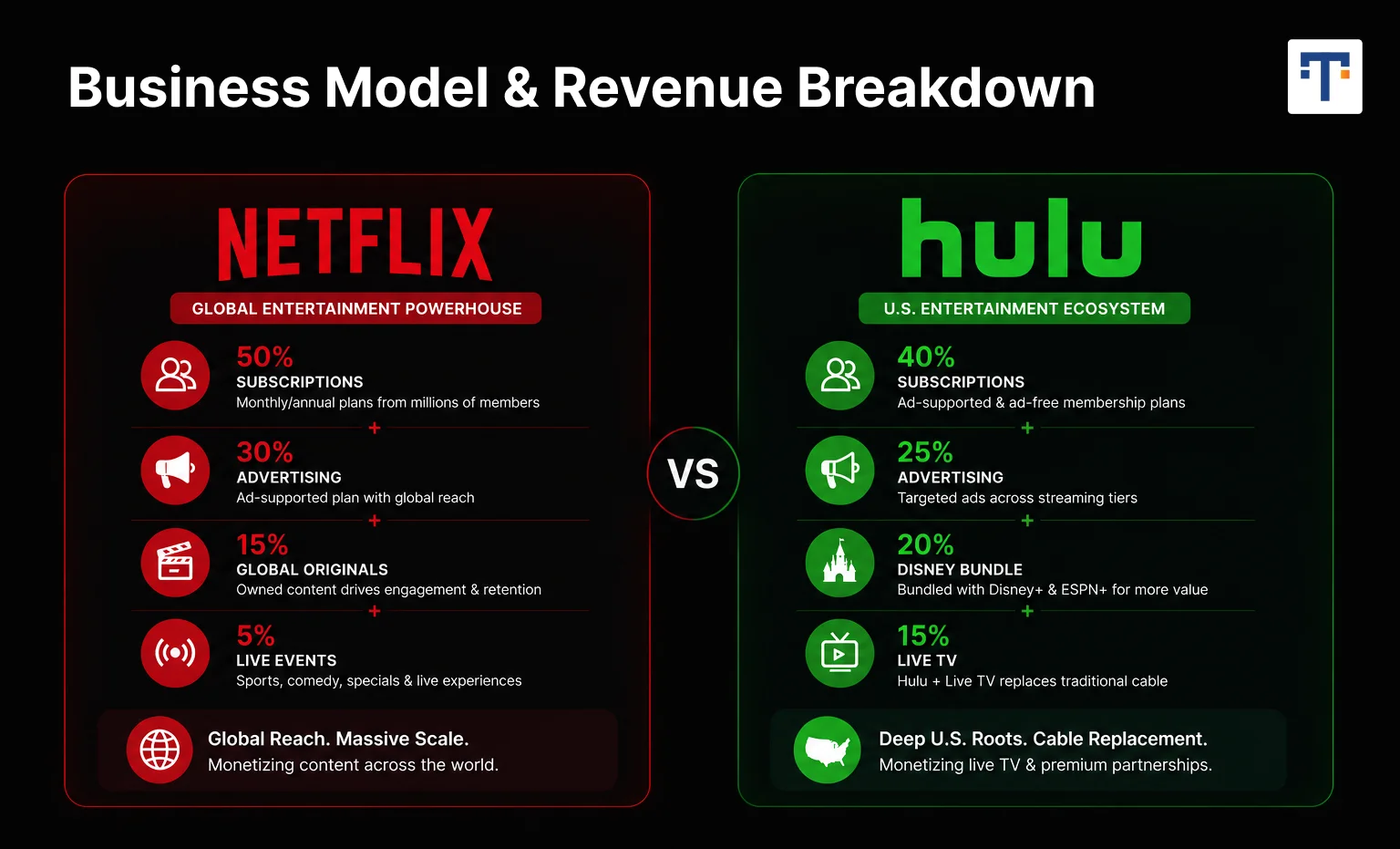
Netflix operates a massive, borderless content engine. In its Q1 2026 shareholder letter ("April 16, 2026 Fellow Shareholders", Netflix Investor Relations), the company reported surpassing 325 million paid memberships globally, generating $12.05 billion in Q4 2025 revenue alone. Netflix's strategy relies on total content ownership and high global engagement. Rather than licensing external network shows, Netflix invests billions in "Netflix Originals" and regional productions (e.g., K-dramas, anime) that translate across international markets. Furthermore, by early 2026, Netflix aggressively expanded into live broadcasting—hosting over 70 live events in Q1 alone, including the World Baseball Classic and major professional wrestling and football partnerships.
Hulu’s Business Strategy (2026)
Hulu’s operational model is strictly domestic (U.S.-only) and deeply intertwined with legacy television broadcasting. According to Q1 2026 industry data tracked by Business of Apps ("Hulu Revenue and Usage Statistics 2026"), Hulu maintains approximately 54 million subscribers. Hulu’s core value proposition relies on the "next-day streaming" model, securing licensing agreements to stream episodes from ABC, Fox, and NBC immediately after their network broadcast.
Following Disney's complete acquisition of Comcast's remaining stake in Hulu, the platform is now functionally the adult-oriented content arm of Disney+. While it maintains its standalone app, its business model heavily incentivizes purchasing the "Disney Bundle" (Hulu, Disney+, and ESPN+). Additionally, Hulu generates substantial Average Revenue Per User (ARPU) through its Hulu + Live TV service, which acts as a direct digital replacement for traditional cable.
Pricing and Revenue Realities
Evaluating the streaming wars requires a direct comparison of subscriber costs and how these platforms monetize their user bases.
| Feature Category | Netflix (Q1 2026 Data) | Hulu (Q1 2026 Data) |
| Global Subscriber Base | ~325 Million (Source: Netflix Q1 Earnings) | ~54 Million (U.S. Only) (Source: Statista/Evoca) |
| Base Ad-Supported Tier | $6.99 / month | $7.99 / month |
| Premium Ad-Free Tier | $22.99 / month (4K Ultra HD) | $17.99 / month (1080p / 4K limited) |
| Live Television Tier | Not Available (Select live events only) | $89.99 / month (Hulu + Live TV) |
| Primary Revenue Driver | Global SVOD Volume + Emerging AVOD | High Domestic ARPU via Live TV + Disney Bundles |
| Ad-Tier Viewership | >250 Million Monthly Active Users | ~60% of total Hulu subscriber base |
The financial strategy of both companies is currently anchored in advertising. Netflix's ad-supported tier now reaches over 250 million global monthly active viewers, representing a massive shift in its revenue model to offset slowing subscriber growth in saturated markets like North America. Conversely, Hulu has operated a highly successful, high-ARPU advertising model for over a decade. Hulu ads have historically commanded high premiums from advertisers due to the platform's ability to target specific demographics effectively during premium network television replays.
Head-to-Head: Content Strategy and User Experience
While financial models dictate corporate success, consumer retention is driven entirely by the content library and viewing experience.
Best Netflix Shows and Content Strategy
Netflix utilizes the "binge model," releasing entire seasons of television series simultaneously. This maximizes immediate viewer engagement and dominates cultural conversation for short, intense periods. The platform holds a distinct advantage in producing global phenomena. Shows like Stranger Things, Squid Game, and unscripted reality television provide unmatched volume. Furthermore, Netflix supports 4K Ultra HD resolution across a much larger percentage of its library compared to competitors, provided the user subscribes to the Premium tier.
Best Hulu Shows and Content Strategy
Hulu utilizes a traditional, episodic release schedule for both its licensed network television and its original programming. For viewers seeking current events, reality television competitions, or network sitcoms, Hulu provides a library that updates daily. Additionally, Hulu serves as the exclusive streaming home for FX Networks. This grants Hulu subscribers access to highly acclaimed prestige television (such as The Bear, Fargo, and Shōgun), positioning the platform as a premier destination for critically recognized adult dramas.
Platform Limitations and Friction
Netflix Limitations:
- The "Revolving Door" Library: Netflix frequently rotates licensed third-party movies and series out of its library, which can frustrate users searching for specific legacy titles.
- Pricing Tiers: Netflix strictly gating its 4K resolution behind its most expensive $22.99/month Premium tier forces users with modern televisions to pay top-market prices to utilize their hardware.
- No Linear Live TV: While expanding into single-event live sports, Netflix cannot replace a traditional cable subscription for local news or continuous sports network coverage.
Hulu Limitations:
- Geographic Restrictions: Hulu remains entirely inaccessible outside of the United States.
- Ad-Intrusion on Premium Tiers: Due to complex streaming rights, even subscribers paying for the "Hulu (No Ads)" tier will still encounter unskippable commercial breaks on a select number of programs.
- Fragmented Application Experience: As Disney integrates Hulu content directly into the Disney+ application interface, users frequently experience navigation friction and overlapping content recommendations.
Switching Costs and Migration
For consumers, the switching costs between streaming platforms are historically low—subscribers frequently cancel and reactivate services month-to-month based on content releases (a behavior known as "churn").
However, the switching costs increase significantly for households utilizing Hulu + Live TV. Migrating away from Hulu's $89.99/month live package to a competitor like YouTube TV requires reprogramming DVR libraries, adjusting to new channel guides, and potentially losing access to the bundled Disney+ and ESPN+ applications. Conversely, Netflix’s primary switching cost is purely social; unsubscribing means losing access to exclusive cultural moments and proprietary algorithms that have mapped a user's viewing habits over several years.
Third-Party Review Perspectives and Market Sentiment
Objective industry data reflects varying levels of subscriber satisfaction in 2026.
- Nielsen Streaming Share: According to Nielsen's periodic "The Gauge" reports, Netflix consistently maintains the highest share of total television viewing time among all individual streaming platforms in the U.S., reflecting its dominance in user engagement.
- Consumer Satisfaction Platforms: Review aggregators and customer satisfaction indexes (such as the ACSI) note that while Netflix retains high marks for application stability and user interface, consumer perception has experienced mild declines due to aggressive password-sharing crackdowns and steady price increases. Hulu maintains consistent satisfaction scores, particularly from older demographics who utilize the Live TV service, but receives frequent criticism regarding its heavy advertising load on base tiers.
Enterprise Decision Framework: Choosing the Right Platform
Determining the superior platform depends entirely on individual household viewing habits and budget constraints.
Choose Netflix if:
- You prioritize high-budget original movies and exclusive, globally recognized television series.
- You prefer the binge-watching model over waiting for weekly episodic releases.
- You own a high-end home theater setup and want access to the largest library of 4K Ultra HD and Dolby Atmos content (via the Premium tier).
- You reside outside of the United States.
Choose Hulu if:
- You want to watch current network television shows (ABC, Fox, NBC) the day after they air without maintaining a traditional cable box.
- You prioritize prestige, critically acclaimed dramas specifically from the FX network.
- You are deeply invested in the Disney ecosystem and want to bundle your general entertainment with Marvel, Star Wars, and live sports via ESPN+.
- You are seeking a comprehensive cable replacement solution (via Hulu + Live TV).
- Ultimately, in the 2026 streaming environment, Netflix secures the position as the essential global entertainment utility, while Hulu operates as the definitive digital replacement for the traditional American television ecosystem