
Introduction
AI coding assistants no longer depend on a single prompt to complete a task. Using loop engineering, they can plan, write, test, and debug code across multiple steps in a continuous workflow, with minimal manual input at each stage. This moves beyond prompt engineering, where developers had to write a new instruction for every task.
Modern AI coding assistants apply loop engineering to autonomously plan software development workflows, functioning as collaborators rather than only generating code on request. This article compares prompt engineering and loop engineering, and explains how loop engineering supports self-directed AI software development.
What Is Loop Engineering in AI Coding?
Loop engineering in AI coding is an approach that uses artificial intelligence systems to execute software development tasks through predefined, iterative workflows instead of many single prompts. The earliest applications of AI in software development, such as prompt engineering, required developers to manually enter a prompt for every task.
That has changed with loop engineering AI coding, as software teams can now instruct autonomous AI coding agents to plan, execute, and refine their output through a continuous execution loop. The agentic coding loop makes a series of decisions within predefined boundaries until set objectives are met or human intervention is required.
Prompt Engineering vs Loop Engineering
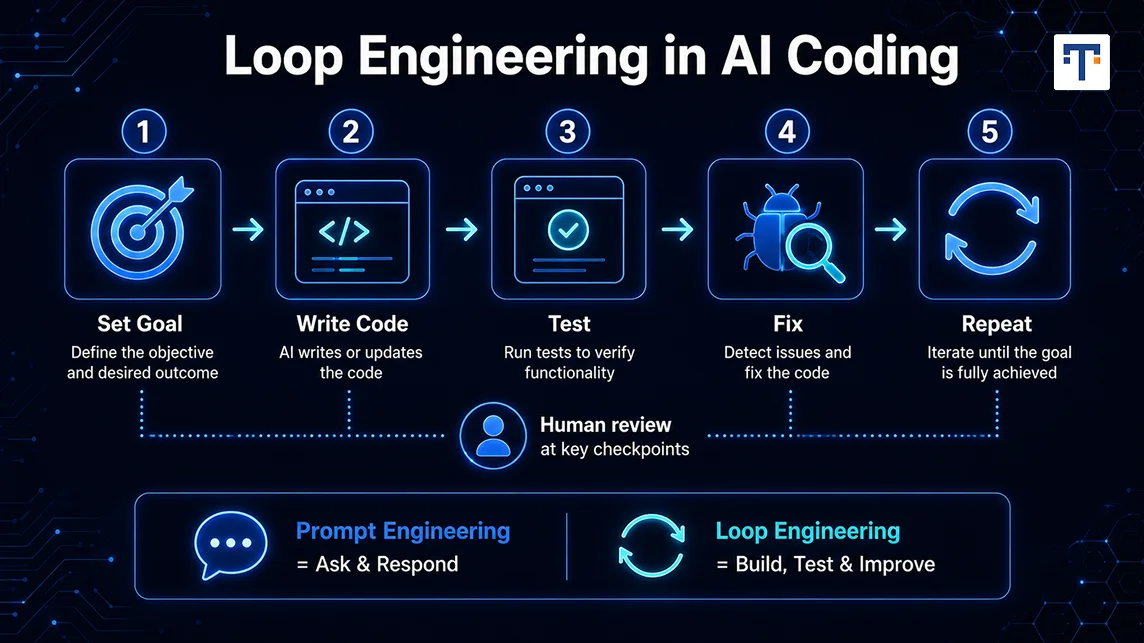
Prompt engineering is about giving instructions to artificial intelligence systems to generate a desired output for a specific task. Below are the differences between prompt and loop engineering in a table:
| Feature | Prompt Engineering | Loop Engineering |
| Method | One prompt, one output | Continuous execution loop until the objective is met |
| Human involvement | Requires frequent human prompting and guidance | Requires minimal human input, mainly at checkpoints |
| Decision making | AI responds only to the current instruction | AI decides the next action based on the results and final objective |
| Error handling | Humans identify errors and test the code manually | AI continuously tests, detects, debugs, and fixes errors |
| Best for | Small tasks, code snippets, and explanations | Complex projects, large refactors, and full feature development |
Core Components of a Loop Engineering System
The key difference between prompt engineering and loop engineering lies in the level of autonomy. Here is a breakdown of how autonomous coding agents complete software development tasks through a loop system.
1. Planning
The planning stage determines the structure of the whole execution loop for the loop engineering AI coding system. This is where the AI interprets the developer’s objective, breaks it into smaller tasks, maps out the code and required resources, and determines an effective sequence to complete the project.
2. Writing Code
The AI coding agents generate new code or modify existing code to meet the project requirements. The actions taken at this stage depend on the task, whether it is to update multiple files, create functions, or implement entirely new features.
3. Running Tests
This step works like a verification stage to confirm whether the generated code functions as expected and complies with quality and performance requirements.
4. Debugging and Fixing Errors
The loop engineering AI coding process passes through this stage when an error occurs while running tests. The autonomous AI coding agents analyze the error, modify the code to resolve the issue, and verify that the problem is solved.
5. Repeating the Loop Until Objectives Are Met
The process does not end after a single execution, and that is why it is called a loop. The AI continuously repeats the planning, coding, testing, and debugging cycle until the predefined objective is reached.
6. Human Approval Checkpoints
The autonomous coding process can be set up with human approval checkpoints to review changes and verify security requirements before deployment.
How Loop Engineering Is Transforming Software Development
Using AI coding assistants for continuous execution instead of isolated coding tasks has improved development efficiency and has allowed developers to focus on higher-value engineering decisions rather than routine tasks. Loop engineering is improving software development in the following ways:
1. Fastest Development Cycles
The ability of autonomous AI coding agents to complete multiple tasks within a single workflow reduces the time required to develop software. Loop engineering AI coding also saves time by coordinating updates across multiple files instead of isolated code edits, especially for large and complex applications.
2. Automated Debugging
Loop engineering AI coding has changed how debugging is performed since agentic coding systems can now identify bugs, investigate the root causes, implement fixes, and verify the final output.
3. Continuous Testing
Continuous testing is a major difference between prompt engineering and loop engineering. For loop engineering, testing is integrated into the development workflow rather than performed after coding is complete.
4. Integration with Modern DevOps Workflows
AI coding assistants for loop engineering are used not only to execute software development projects with predefined objectives but also to integrate with automated testing pipelines, version control systems, and development workflows to support continuous integration and continuous delivery (CI/CD).
How the Popular AI Coding Assistants Apply Loop Engineering
Loop engineering across AI coding assistants, such as Claude Code, GitHub Copilot, and OpenAI Codex, does not work exactly the same way. While they can participate in loop-based, agentic software development workflows, the difference lies in the level of autonomy expected and how closely the developer remains involved.
1. Claude Code
Claude Code loop engineering emphasizes continuous interaction with the codebase and terminal. The developer can assign the broader objective for Claude to interpret, analyze the codebase, modify multiple files, and run commands and tests within the same environment. It is best suited for large-scale refactoring, debugging, and projects that require coordinated changes across an application.
2. GitHub Copilot
GitHub Copilot is a popular coding assistant that sometimes runs with less autonomy than Claude Code. It uses a human-in-the-loop approach inside the IDE. GitHub Copilot is excellent for teams already using GitHub and popular IDEs, such as VS Code, who want AI assistance while maintaining direct control over existing coding processes.
3. OpenAI Codex
OpenAI Codex for software development applies loop engineering by allowing developers to delegate defined tasks to an AI agent. Codex can work on the assigned task in an isolated environment and evaluate the results before returning the completed work for review by the developer. It does not require step-by-step guidance like GitHub Copilot.
Challenges and Limitations of Loop Engineering
Applying loop engineering in software development to keep running without constant prompting may face challenges regarding who owns accountability for the AI-generated code due to the following:
Limited Understanding of Full Business Requirements
Agentic coding systems may not fully understand long-term business goals or decisions that are not documented in the project. The AI coding assistant can take technically correct actions that do not fit into the broader needs of the application.
Errors Can Compound Across the Loop
Successful execution of continuous automated coding steps does not always mean the AI is correct. For example, if the AI misunderstands a requirement at the beginning of the loop engineering workflow, the subsequent steps may follow that wrong implementation.
Security and Code Quality Risks
Loop engineering systems can introduce security vulnerabilities if the AI coding agent introduces insecure code or modifies sensitive parts of an application. This is why developers are recommended to review important updates before implementing changes.
Conclusion
Loop engineering represents the potential of self-directed AI software development as agentic coding shifts from one-time prompts to continuous execution models. However, a common misconception is that developers will become less important, or that prompt engineering is no longer needed.
While developers will have fewer routine responsibilities due to autonomous coding agents, their expertise remains valuable for human oversight to ensure accountability in AI-driven development. Software developers will still require prompt engineering knowledge as they need to provide clear instructions, context, and objectives that help the AI coding assistants work effectively.