
Introduction
The enterprise conversation surrounding artificial intelligence usually centers on productivity metrics, hardware costs, and workforce displacement. We spend endless hours debating whether a generative model will eliminate the junior developer or replace the financial analyst. Yet, a much quieter, perhaps more insidious shift is happening across our workflows. We are rarely discussing what happens to the human brain when it no longer has to struggle with a blank page.
Many professionals are quietly asking themselves a difficult question: Is AI killing creativity?
When we outsource the initial friction of thought to a large language model, we save time. However, we also bypass the exact cognitive friction required to form an original point of view. The threat of the current technology cycle is not that a machine will take your job. The risk appears to be that the machine will slowly erode your ability to sit with a complex problem and actually think it through.
Executive Summary: The Cognitive Cost of Automation
- The Core Risk: The primary threat of generative tools is not workforce replacement, but cognitive dependency. Outsourcing the friction of thought weakens our ability to form original ideas.
- The 2026 Data: Recent large-scale testing indicates that while models generate a higher volume of ideas, humans still score higher on originality, lateral thinking, and relevance.
- The Atrophy Effect: Erasing the "messy middle" of the creative process removes the phase where disparate concepts are connected to form unique business logic.
- The Mitigation Strategy: To maintain mental sharpness, professionals should position AI as a sparring partner or a critic, rather than an initial creator.
The 2026 Creativity Study: Volume Versus Originality
To understand the current AI impact on human creativity, we have to look at the data rather than the marketing material. In early 2026, the Cognitive Research Institute published a massive comparative analysis, pitting the latest generation of foundational models against 100,000 human professionals across various standardized creativity assessments.
The findings offer a highly specific look at how AI is affecting creativity. When tasked with alternative uses tests (generating as many ideas as possible for a standard problem), the AI won decisively. The models produced hundreds of variations in a matter of seconds. They won on sheer volume.
However, humans retained a distinct advantage in the metrics that actually drive business value. When the outputs were graded blindly by independent panels for originality, emotional resonance, and lateral problem-solving, the human cohort scored measurably higher. The AI was exceptionally good at finding the mathematical average of existing information. It interpolated perfectly. The humans, despite being slower and producing fewer total ideas, extrapolated. They connected completely unrelated concepts—a marketing strategy inspired by 19th-century architecture, or a supply chain solution derived from biological ecosystems.
This data may suggest that AI replacing creative thinking is a misplaced fear. The models are not inherently more creative than we are. But the study highlighted a secondary, behavioral warning: humans who heavily relied on the AI for their initial brainstorming sessions eventually began to mimic the model's average, predictable output.
The Problem with Removing Friction
The process of generating a good idea is historically uncomfortable. Whether you are drafting a highly technical product requirements document or writing a brand manifesto, staring at a blank screen forces your brain to retrieve, organize, and synthesize information. You write a terrible first sentence, delete it, pace the room, and try again.
That frustration is not a bug in the human operating system; it is the mechanism by which we learn.
When you type a prompt and receive a perfectly formatted, B-minus draft in three seconds, that friction disappears. The effects of AI on creativity are largely tied to this convenience. If a marketing director asks a model to outline a campaign brief, they are skipping the mental struggle of deciding what actually matters. The resulting document will be structurally flawless, grammatically correct, and entirely forgettable.
Is overusing AI harmful to creative thinking? The operational reality suggests it is. We are conditioning ourselves to accept the first plausible answer a machine provides. The more we do this, the less we practice the mental endurance required to push past the obvious. It is similar to relying so heavily on GPS navigation that you lose your innate sense of direction in your own neighborhood. The tool works perfectly, but your internal capacity slowly atrophies.
Can AI Replace Human Creativity?
When executives ask, "can AI replace human creativity?", they are usually treating creativity as a localized task rather than a broader cognitive function.
Foundational models operate on probabilistic text generation. They predict the next most likely word based on the billions of words they have ingested. By definition, a system designed to predict the most likely outcome struggles to produce a highly unlikely—and therefore original—idea. They train on the past. Human imagination operates on the future, frequently breaking established patterns to find new utility.
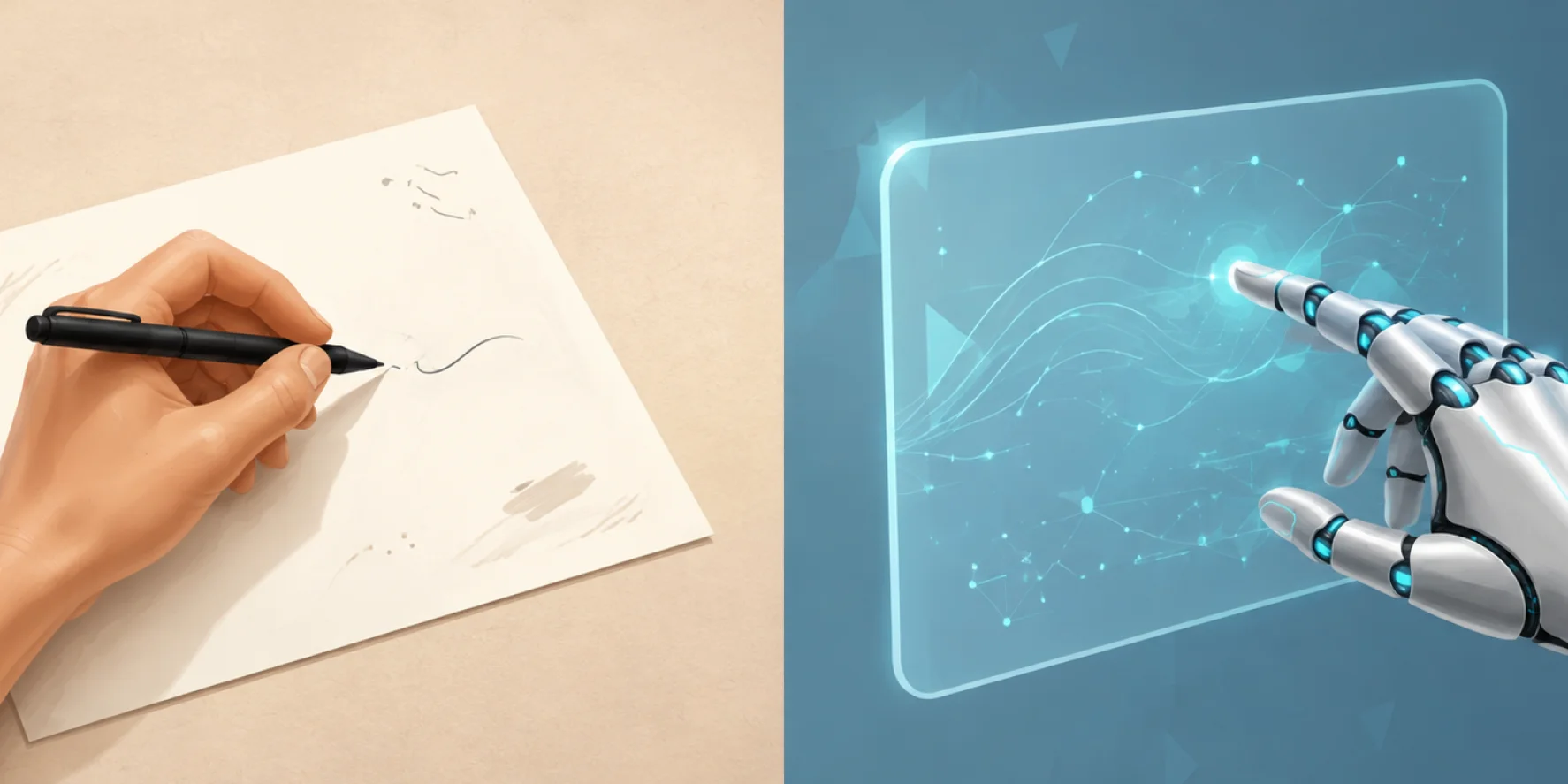
Will AI replace human imagination? It is highly improbable. But it can certainly mimic the output of imagination well enough to satisfy a tight deadline. This is where the enterprise risk lies. If a company's internal culture prioritizes speed over originality, employees will naturally default to the machine. Over a timeline of three to five years, a company running entirely on AI-generated strategy runs the risk of sounding exactly like its competitors, because they are all querying the same underlying datasets, making a strong AI investment strategy more important than ever.
The Dependency Trap and Critical Thinking
The conversation naturally shifts toward a related concern: can AI weaken critical thinking skills?
When a junior financial analyst relies on a model to summarize a 200-page regulatory filing, they receive a neat, bulleted list of the main points. They save four hours of reading. What they lose, however, is the peripheral context. They miss the subtle tone of the regulatory language, the minor footnote on page 42 that might impact their specific client, and the mental mapping required to understand how the entire document connects.
When you outsource the reading, you outsource the thinking. AI and loss of creativity are directly linked to this loss of critical evaluation. If you do not consume the raw material, you cannot form a unique hypothesis about it. You become an editor of average thoughts rather than a generator of new ones.
How to Stay Creative While Using AI
Technology is rarely rolled back. Pretending these tools do not exist is a fast track to professional irrelevance. The goal is not to abandon the technology, but to establish a framework for how to stay creative while using AI.
If you want to protect your cognitive abilities while still meeting modern productivity demands, consider applying these specific constraints to your daily workflow.
1. Generate the Premise Yourself
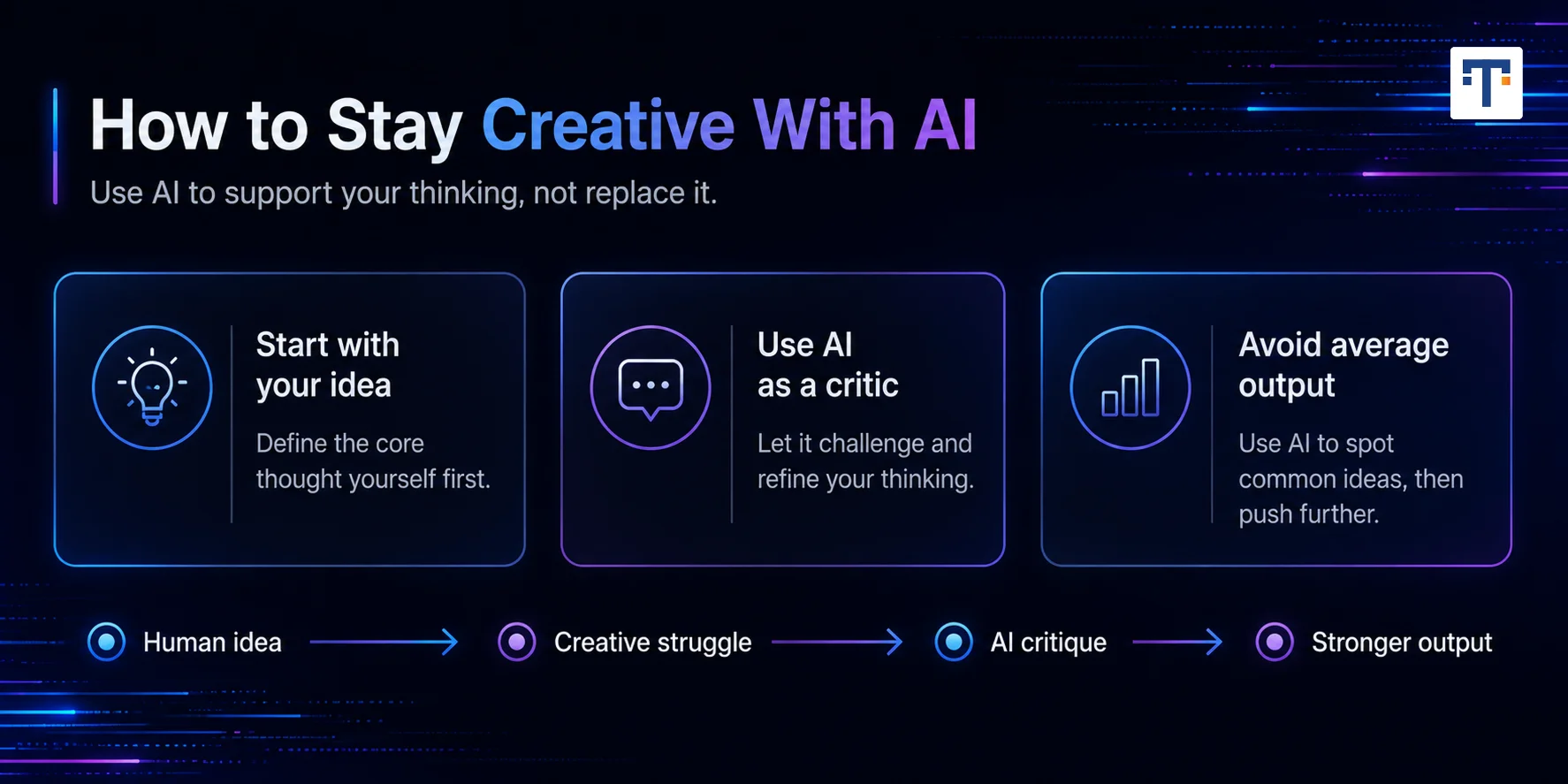
Never use a model to generate the core thesis of your work. If you are writing a strategic memo, decide what your stance is before you open the prompt box. Write your main argument on a physical piece of paper. Once you have done the hard work of taking a position, you can use the model to help format the data, generate counter-arguments, or clean up the syntax. Own the premise; outsource the polish.
2. Use the Tool as a Critic, Not a Creator
Instead of asking a model to "write a plan for X," try reversing the dynamic. Write your own plan, paste it into the system, and prompt it with: "Act as a highly skeptical chief financial officer. Review this plan and point out the three weakest assumptions I am making." This forces the AI to challenge your human creativity, rather than replacing it. It turns the machine into a sparring partner, which actually elevates your critical thinking skills.
3. Restrict the Context Window
When brainstorming, do not ask the model to give you ten ideas. Ask it to give you the ten most common, cliché ideas for your specific problem. Review that list, and use it as a map of what not to do. By having the machine identify the mathematical average of the industry, you immediately know which concepts to avoid, forcing your brain to look for the less obvious, highly original angle.
The Choice Before Us
We are currently navigating a strange transition period. The tools we use to do our jobs are now capable of doing a passable version of the jobs themselves.
Is AI making people less creative? The technology itself is neutral. It is the human desire for convenience that drives the cognitive decline. If we treat these models as a replacement for the struggle of thought, our collective output will become increasingly generic.
However, if we maintain discipline, we can use these systems to handle the administrative weight of our workflows, clearing our schedules to focus on the deep, lateral thinking that machines cannot replicate. The ability to sit quietly in a room, wrestle with a difficult concept, and build something entirely new is not a legacy skill. In a market flooded with automated, average content, human originality is about to become the most expensive commodity in the enterprise.
Frequently Asked Questions (FAQ)
1. Will AI replace human imagination?
It is unlikely. Generative models operate by predicting the most probable arrangement of existing data based on historical training. Human imagination is characterized by extrapolation—the ability to connect unrelated concepts and break established patterns. While AI can simulate creative output, true imagination requires a departure from the "most likely" answer, a space where human cognition still holds a distinct advantage.
2. How can I use AI without losing creativity?
The most effective method is to alter the order of operations. Always establish your core premise, argument, or idea independently before consulting a model. Utilize the technology to critique your work, format unstructured data, or identify common clichés to avoid, rather than relying on it to generate the initial concept.
3. Is overusing AI harmful to creative thinking?
The current data appears to indicate that heavy reliance on generative tools can lead to cognitive atrophy. When individuals continually bypass the mental friction required to solve a problem, they risk becoming dependent on the tool, often resulting in output that regresses to the mean and lacks original perspective.
4. Can AI weaken critical thinking skills?
Yes, if used as a substitute for primary research and synthesis. Relying on AI to summarize lengthy documents or generate business logic deprives the user of the peripheral context and mental mapping required to deeply understand a subject. True critical thinking requires engaging with the raw material directly.