In this article
Stripe vs PayPal: Most Businesses Are Choosing the Wrong One
In this article
Introduction
When launching a new product or upgrading digital infrastructure in 2026, technology leaders and founders face a critical decision regarding their payment gateway. Despite the maturity of the financial technology sector, a significant number of businesses continue to select their payment processor based entirely on brand familiarity rather than architectural fit.
Both Stripe and PayPal process payments successfully on a global scale. However, they are engineered for fundamentally different business models. Selecting the incorrect platform frequently leads to one of two outcomes: overpaying by thousands of dollars annually in transaction fees, or encountering severe technical debt that forces a complete infrastructure rebuild six months into deployment. This payment processor comparison bypasses the standard marketing narratives to examine the operational realities, helping decision-makers align their financial technology stack with their actual revenue mechanisms.
Executive Summary: Core Differences at a Glance
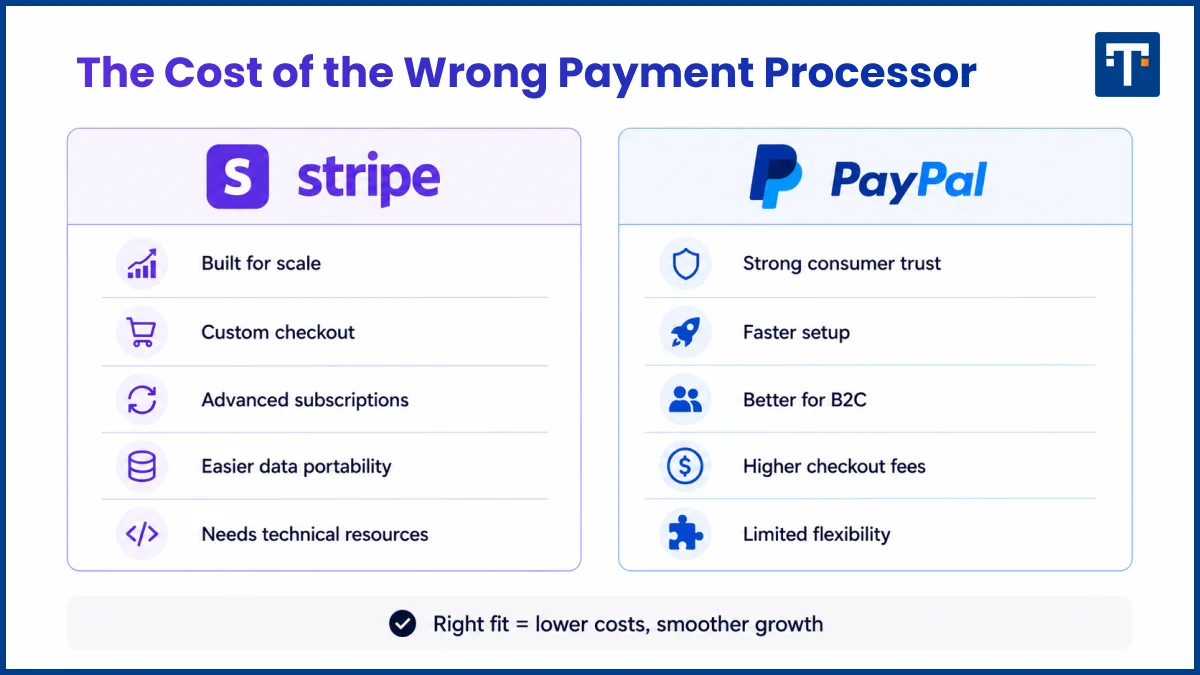
- Architectural Focus: Stripe operates as an API-first platform designed for developer control and deep customization. PayPal operates primarily as a consumer-facing digital wallet optimizing for brand trust and rapid checkout.
- Pricing Model: While baseline rates appear similar, effective costs diverge significantly based on cross-border volume, subscription management needs, and the specific checkout integrations utilized.
- Best-Fit Case for Stripe: SaaS platforms, B2B enterprises, marketplaces, and businesses requiring complex, highly customizable subscription billing logic without redirecting the customer.
- Best-Fit Case for PayPal: High-volume B2C e-commerce retailers, businesses needing instant setup without dedicated engineering resources, and merchants prioritizing guest-checkout conversion rates.
The Core Divide: Developer Control vs. Brand Recognition
To accurately answer the question, is Stripe better than PayPal?, organizations must first evaluate their internal engineering capabilities and their target customer demographic.
Stripe functions as invisible infrastructure. The company’s primary focus has always been the developer experience, providing clean, extensively documented APIs that allow a business to build a completely white-labeled checkout flow. When a customer pays via Stripe, they rarely realize Stripe is processing the transaction; they remain on the merchant’s domain from product selection to receipt. This architecture appears to favor companies that prioritize brand consistency and control over the entire user journey.
PayPal approaches payments from the opposite direction. It is an established, consumer-facing financial entity. For over two decades, the PayPal button has served as a widely recognized trust signal for online shoppers. When integrating standard PayPal checkout, the customer is typically redirected away from the merchant’s website to authenticate the payment on PayPal’s domain before being returned. While this introduces a redirect, the presence of the PayPal logo frequently functions as a conversion mechanism for consumers hesitant to enter raw credit card data on an unfamiliar website.
Stripe vs PayPal Transaction Fees 2026: Which is Cheaper?
When organizations ask, how much does Stripe cost vs PayPal?, the answer requires a close examination of the specific payment methods being routed through the respective gateways. The baseline transaction fees for 2026 reveal a nuanced pricing structure.
| Fee Category | Stripe | PayPal |
| Standard Domestic Credit/Debit | 2.9% + $0.30 | 2.59% + $0.49 (Advanced Credit/Debit) |
| Standard Digital Wallet Checkout | 2.9% + $0.30 (Apple Pay / Google Pay) | 3.49% + $0.49 (PayPal Checkout) |
| International Transactions | + 1.5% (plus 1% if currency conversion is needed) | + 1.5% |
| Chargeback Fee | $15.00 | $20.00 |
| Micro-transactions (under $10) | Standard rates apply (custom pricing requires negotiation) | Specialized micro-transaction rates available |
| Payouts to Bank | Free (Standard 2-day) / 1.5% (Instant) | Free (Standard) / 1.5% (Instant) |
Which is cheaper, Stripe or PayPal? If a business is strictly processing standard domestic credit cards using an integrated form, PayPal’s Advanced Credit and Debit checkout (2.59% + $0.49) can yield marginal savings on higher-ticket items compared to Stripe’s flat 2.9% + $0.30.
However, if a business relies heavily on the standard, redirect-based PayPal Checkout button, the cost spikes to 3.49% + $0.49 per transaction. For a merchant processing $1 million annually in $50 increments, that 0.59% difference, combined with the higher fixed per-transaction fee, translates to thousands of dollars in lost margin. Therefore, identifying the best payment processor for online business requires modeling exact average order values against these specific fee structures.
Stripe vs PayPal for Subscriptions
The complexity of recurring revenue models often forces a decisive split between these two platforms. When evaluating is PayPal good for subscription businesses?, the technical consensus suggests that while it functions adequately for basic, flat-rate monthly billing, it struggles under the weight of modern SaaS requirements.
Stripe Billing is widely regarded as the industry standard for recurring revenue. The API natively handles complex logic that SaaS companies require: pro-rating upgrades and downgrades mid-billing cycle, usage-based (metered) billing, and pausing subscriptions. Crucially, Stripe includes an automated “dunning” process—an intelligent system that automatically emails customers and retries failed credit cards at mathematically optimal times to recover lost revenue.
PayPal offers a subscription product, but its architecture remains somewhat rigid. Implementing tiered pricing, handling mid-cycle prorations, or integrating smoothly with third-party billing software frequently requires complex workarounds or reliance on older, fragmented API documentation. For businesses operating software-as-a-service or complex membership communities, Stripe’s infrastructure generally provides a far superior operational foundation.
Checkout Conversion Rates: The Trust Factor
Cost is irrelevant if the customer abandons the shopping cart. When evaluating the PayPal checkout conversion rate, the platform’s consumer brand recognition provides a tangible advantage for specific business models.
Independent e-commerce data from 2025 and 2026 indicates that for direct-to-consumer (DTC) brands and newer e-commerce retailers, offering PayPal as an option increases overall conversion rates by up to 18%. Many consumers prefer bypassing manual credit card entry in favor of a one-click PayPal login.
Stripe combats this by natively supporting Apple Pay and Google Pay within its checkout elements, which offer similar biometric, one-click convenience. However, restricting a B2C storefront entirely to Stripe means forfeiting the segment of the market that exclusively trusts PayPal for online transactions.
Migration and Switching Costs
A critical blind spot in enterprise payment strategy is the cost of migrating away from a platform once deployed.
If a business scales and decides to leave Stripe, the company adheres to strict data portability standards. Upon request, Stripe will securely transfer a merchant’s tokenized customer credit card data directly to another PCI-compliant payment processor. This allows a business to change vendors without forcing thousands of active subscribers to manually re-enter their billing information.
Historically, migrating away from PayPal is notoriously difficult. PayPal generally views the consumer as their customer, not the merchant’s. Exporting vaulted credit card data out of the PayPal ecosystem to a competing processor is often restricted or heavily delayed. Consequently, businesses that start with PayPal and later attempt to migrate to a more robust SaaS billing platform frequently experience massive subscriber churn during the transition process.
Platform Limitations
No financial infrastructure is without fault. An objective evaluation requires acknowledging the structural limitations inherent to both systems.
Stripe Limitations:
- Technical Barrier to Entry: While Stripe offers no-code Payment Links, maximizing the platform’s value requires dedicated software engineering resources to implement and maintain the API integrations.
- Aggressive Risk Management: Stripe’s automated fraud detection system (Stripe Radar) is highly sensitive. Businesses in historically “high-risk” categories (e.g., specific digital goods, event ticketing) occasionally report sudden, automated account holds or fund freezes with limited immediate human support.
PayPal Limitations:
- Fragmented Documentation: Over the decades, PayPal has acquired multiple payment gateways (like Braintree) and updated its APIs numerous times. Developers frequently cite frustration with navigating deprecated documentation and disjointed integration portals.
- Brand Intrusion: PayPal heavily prioritizes its own branding and user acquisition, often introducing visual clutter or promotional messaging for its own credit products during a merchant’s checkout flow.
Third-Party Review Perspectives
Analysis of leading B2B software review aggregators corroborates these operational realities:
- Gartner Peer Insights & G2 (2025/2026 Data): Stripe consistently maintains superior ratings among software engineers, product managers, and CIOs for its API reliability, extensive documentation, and subscription management logic. PayPal receives high satisfaction scores from small-to-medium business (SMB) owners and e-commerce managers who praise the speed of initial setup and the immediate consumer trust the logo provides, though technical users frequently rate its developer experience poorly in comparison to Stripe.
Enterprise Decision Framework: Choosing the Right Processor
Selecting between Stripe and PayPal is not a matter of determining which company is inherently better; it is a matter of diagnosing your specific business structure.
Choose Stripe if:
- You operate a SaaS, platform, or marketplace business requiring complex recurring billing, usage-based metering, or multi-party payouts.
- You employ a dedicated engineering team capable of customizing a white-labeled checkout flow to maximize brand consistency.
- You anticipate future platform migrations and require the ability to securely export tokenized customer data.
- Your customer base is primarily B2B, where corporate cards are standard and digital wallet trust signals are less necessary.
Choose PayPal if:
- You operate a B2C e-commerce storefront or sell physical goods where establishing immediate trust with retail consumers is critical to conversion.
- You lack in-house technical resources and need to launch a functional payment gateway immediately using standard e-commerce plugins.
- Your transaction volume is heavily weighted toward international buyers who rely on PayPal as their primary digital currency intermediary.
Ultimately, the most sophisticated digital retailers do not limit themselves to a binary choice. By integrating Stripe as the core invisible infrastructure for credit card processing and subscription logic, and offering PayPal merely as a secondary, alternative payment button at checkout, businesses can capture the specific advantages of both ecosystems.

Tech Insights Digest
Sign up to receive our newsletter featuring the latest tech trends, in-depth articles, and exclusive insights. Stay ahead of the curve!