In this article
AI Buying Checklist for CIOs: What to Consider Before You Invest
In this article
Introduction
In 2026, enterprise artificial intelligence has transitioned from isolated pilot programs to a mandatory component of digital infrastructure. According to recent projections from Gartner, global AI spending is expected to reach $2.5 trillion in 2026. For Chief Information Officers (CIOs), the mandate has definitively shifted. The objective is no longer acquiring technology based on early market enthusiasm; it is about establishing a rigorous AI investment strategy for CIOs that prioritizes measurable returns, robust data governance, and secure integration. Selecting the right AI solution requires a disciplined evaluation of scalability, infrastructure limits, and long-term risk. This checklist provides decision-makers with a practical framework to navigate complex vendor landscapes and ensure their investments align with concrete business outcomes.
Executive Summary: The CIO AI Investment Framework
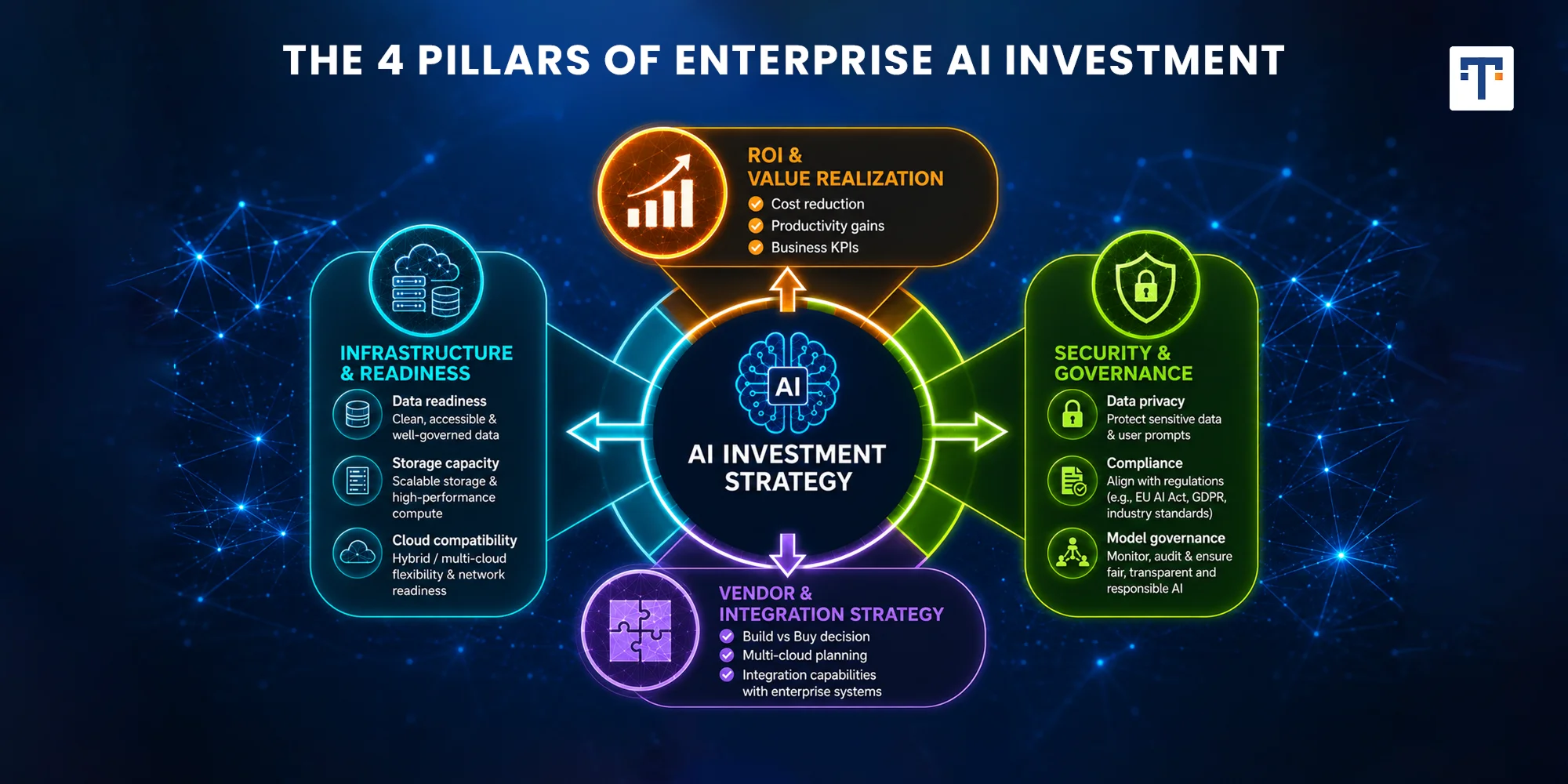
- Infrastructure & Data Readiness: Evaluating whether existing data pipelines and network architectures can handle the intensive demands of modern AI models.
- Security & Risk Governance: Establishing strict access controls, addressing data privacy, and implementing frameworks for compliant AI usage.
- Integration & Vendor Strategy: Assessing the choice between building custom models, purchasing enterprise licenses, or adopting a multi-cloud approach to avoid dependency.
- ROI & Value Realization: Shifting focus from raw technological capabilities to tracking specific key performance indicators, such as time-to-resolution and operational cost reduction.
Assessing Data and Infrastructure Readiness
Before committing capital to an AI platform, organizations must honestly assess their internal foundation. Current industry data suggests that advanced AI models require highly structured, governed data to function accurately.
Organizations should evaluate whether they have a unified data pipeline or if critical business information remains trapped in fragmented, inaccessible silos. Implementing an AI solution on top of poor data architecture frequently leads to inaccurate AI-generated responses.
Furthermore, infrastructure capacity remains a physical bottleneck. Severe shortages in power infrastructure, particularly transformers and switchgear, are limiting on-premises AI workloads globally. CIOs must evaluate whether their data centers possess the necessary high-speed storage and computing power, or if a rapid transition to a hybrid cloud environment is required to support the processing load.
Evaluating Security, Compliance, and Risk
Deploying artificial intelligence at scale introduces significant new security vectors that IT departments must manage.
Data privacy remains a primary concern. Decision-makers must ensure the vendor provides strict, legally binding guarantees that corporate data and user prompts are never utilized to train their public foundational models. With frameworks like the European Union’s AI Act now actively enforced, CIOs must also verify that the tools comply with regional and industry-specific regulations.
Additionally, organizations need to implement observability tools to monitor for “model drift”, the gradual degradation of an AI model’s accuracy over time as the data it encounters diverges from its training baseline. Establishing protocols to detect and correct these anomalies is necessary before they negatively affect automated business operations.
The Build vs. Buy Decision Framework
Organizations face a critical choice between developing proprietary models or procuring out-of-the-box enterprise solutions. This decision framework helps clarify the appropriate path based on specific corporate needs.
| Decision Factor | “Build” (Custom LLMs & Open Source) | “Buy” (Commercial AI Solutions) |
| Primary Advantage | Absolute control over data architecture; highly customized to niche industry logic. | Rapid deployment; native integration with existing SaaS platforms. |
| Cost Structure | High initial capital expenditure for compute power and specialized engineering talent. | Predictable operational expenditure via per-user monthly licensing. |
| Maintenance Burden | Requires continuous internal monitoring for model drift, updates, and security patching. | Vendor manages underlying model updates, security patching, and infrastructure scaling. |
| Best Fit For | Organizations with highly proprietary data and advanced internal data science teams. | Enterprises seeking immediate productivity gains in standard office and operational workflows. |
Mitigating Vendor Dependency Through Multi-Cloud Strategies
A significant risk in enterprise AI adoption is severe vendor dependency. Relying exclusively on a single provider for infrastructure, foundational models, and workflow agents may severely limit future operational flexibility.
CIOs should actively evaluate adopting a multi-cloud AI strategy. This approach can reduce long-term risk by allowing organizations to route specific workloads to the most efficient cloud environments. For example, a company might utilize one vendor for structured financial analytics while leveraging another platform entirely for multimodal generative tasks. Distributing workloads across containerized environments, such as Kubernetes, helps preserve negotiating leverage and technical agility.
Environmental Impact and Green AI
As compute power demands escalate, the environmental footprint of AI data centers is becoming a critical evaluation metric rather than a secondary concern. TechTarget highlights that executives making AI decisions must increasingly consider “green AI” initiatives. Assessing a vendor’s data center energy efficiency and their commitment to sustainable power sources serves as a vital component of long-term risk management, especially as global energy constraints and reporting regulations tighten.
Conclusion
An effective AI investment strategy for CIOs requires prioritizing business alignment over technological enthusiasm. By systematically addressing data readiness, enforcing strict governance, and objectively evaluating long-term infrastructure capabilities, technology leaders can deploy systems that act as secure, scalable drivers of enterprise value.
Frequently Asked Questions (FAQ)
1. What is the most critical factor in an AI investment strategy for CIOs?
Data readiness is widely considered the foundational element. Without clean, centralized, and strictly governed data, even the most advanced AI solutions will struggle to deliver accurate insights or automate workflows effectively.
2. How can enterprises avoid AI vendor lock-in?
Organizations can mitigate vendor dependency by adopting a multi-cloud architecture, utilizing containerized environments for portable workloads, and prioritizing open-source models for specific tasks where expensive commercial models are unnecessary.
3. What are the hidden costs of enterprise AI adoption?
Beyond the initial licensing fees or hardware costs, CIOs must budget for ongoing data preprocessing, continuous model tuning, specialized cybersecurity audits, and the organizational change management required to train employees.
4. How do we ensure our AI implementation remains compliant with new regulations?
Enterprises should establish an internal AI governance committee, integrate automated compliance checks directly into the deployment pipeline, and select vendors that offer transparent, auditable logging of AI decision-making processes

Tech Insights Digest
Sign up to receive our newsletter featuring the latest tech trends, in-depth articles, and exclusive insights. Stay ahead of the curve!