In this article
Microsoft Copilot vs. Google Gemini for Enterprise: A Real-World Productivity Showdown
In this article
Introduction
As enterprises push past the initial stages of AI implementation, the focus has shifted from experimental capabilities to tangible business outcomes. IT leaders and professionals are actively seeking solutions that provide realistic operational efficiency and verifiable returns on investment. The enterprise AI landscape has largely consolidated two primary contenders: Microsoft Copilot, deeply integrated into the Microsoft 365 ecosystem, and Google Gemini, powering Google Workspace.
Both promise to enhance workflows, but which platform actually delivers measurable productivity gains in day-to-day enterprise workflows? To evaluate these platforms under real-world business constraints, we must look beyond vendor marketing.
The Architectural Divide: Graphs vs. Context
To understand how these tools behave, it is essential to examine how they retrieve information. This underlying structure dictates whether a prompt returns an effective operational shortcut or an inaccurate AI-generated response.
Microsoft Copilot runs on the Microsoft Graph, which functions as a highly relational map of corporate communications. It tracks the operational reality of daily workflows—identifying email recipients, active Teams channels, and accessed SharePoint directories. When a user asks Copilot a question, it queries this Graph to retrieve relevant, access-controlled organizational data before passing it to OpenAI’s foundational models. It excels at situational awareness; the system inherently recognizes that a draft proposal is closely linked to a previous strategy meeting.
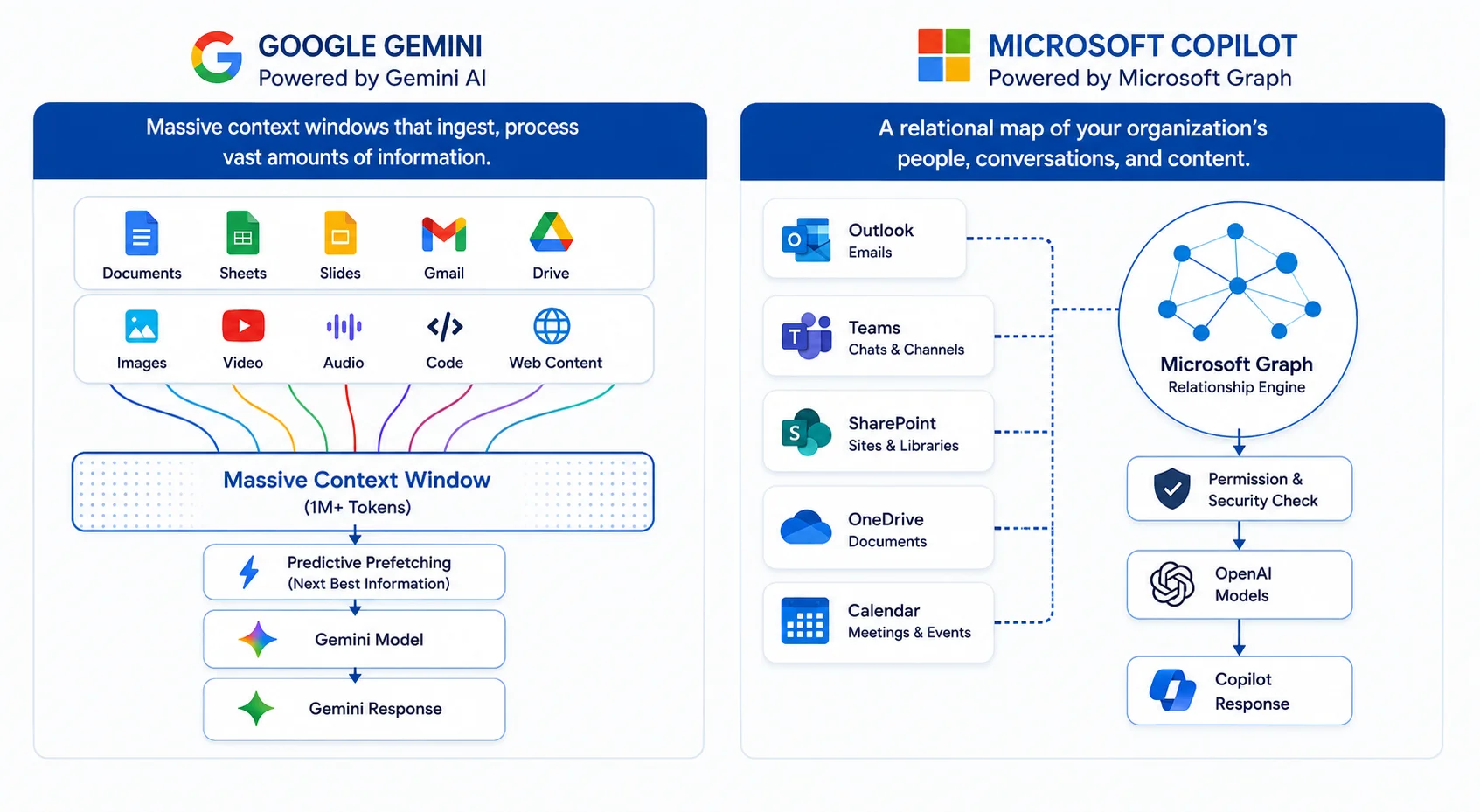
Google Gemini operates on a different computational premise. Rather than relying heavily on a relational graph, it utilizes massive context windows capable of processing a million tokens or more in a single prompt. If Microsoft reads the specific chapters of a workday, Gemini attempts to process extensive amounts of enterprise data simultaneously. Using predictive prefetching, Google’s architecture retrieves files for the next likely question while generating the current answer.
This difference influences practical applications. Microsoft’s approach favors traditional, document-dense organizations with rigid hierarchies. Google’s approach is highly suited for digitally native organizations that manage extensive unstructured video, code, and raw data.
Evaluating Enterprise ROI and Pricing Models
Moving from an experimental pilot to an enterprise-wide rollout requires robust financial justification. Independent evaluations, specifically Forrester Consulting’s The Total Economic Impact™ of Microsoft Copilot for Microsoft 365 (published late 2025) and The Total Economic Impact™ of Google Workspace with Gemini (published early 2026), highlight two distinct commercial strategies.
Both platforms offer tiered subscriptions, and on the surface, they look fairly similar.
| Feature Category | Copilot for Microsoft 365 | Gemini for Google Workspace |
| Underlying Engine | Microsoft Graph + OpenAI | Gemini AI Fabric + Context Engine |
| Core Architecture | Highly relational, document-heavy indexing | Massive context windows (1M+ tokens), multimodal |
| Spreadsheet Approach | Native Python integration for local modeling | Cloud-scale =AI() formulas for bulk processing |
| Ecosystem Integration | Deep across Word, Excel, Teams, PPT | Across Docs, Sheets, Meet, Slides |
| Projected ROI (3-Year) | 116% to 353% (Source: Forrester TEI) | 416% (Source: Forrester TEI) |
| Average Time Saved | ~4 to 10 hours per month | ~12.5 hours per month |
| Security/Governance | Enterprise Data Protection (Inherited) | Google Workspace Admin Controls |
| Enterprise Pricing | ~$30 / user / month (add-on) | Included in many Workspace plans; effective pricing typically ~$14–30/user/month depending on tier |
The disparity in ROI percentages is influenced by how these tools are packaged. Microsoft positions Copilot as a premium service, requiring an extra $30 per user, per month, on top of existing commercial licenses. This higher barrier to entry mathematically lowers the initial ROI percentage due to the required capital expenditure. However, the financial impact is substantial; achieving peak productivity for new hires 11 days faster translates into significant recovered labor value.
Google integrates Gemini directly into its core Google Workspace Enterprise plans. Because the AI capabilities are native rather than a separate add-on, the cost denominator decreases, resulting in an ROI projection exceeding 400%.
However numbers on a spreadsheet only tell half the story. We need to look at the daily friction.
Head-to-Head: The Daily Grind
While both platforms boast similar features, their practical utility varies based on specific tasks.
1. Microsoft Word vs. Google Docs
In Google Docs, Gemini generates highly cohesive blog posts and project briefs, often maintaining a natural tonal quality. However, Word holds a distinct advantage due to cross-application capabilities. Copilot can generate a first draft based on an Outlook thread and immediately convert that Word document into a complete PowerPoint presentation, including speaker notes. This cross-application execution saves significant time for management roles.
2. Microsoft Excel vs. Google Sheets
Microsoft integrated native Python directly into Excel. Users can input a plain-English request to audit a deeply nested XLOOKUP formula, and Copilot translates that into executable Python code. For complex, financial forecasting, the desktop version of Excel maintains a distinct advantage. Google Sheets approaches data through the cloud. The =AI() function allows for scalable bulk processing, such as pasting thousands of unstructured customer surveys into a column and categorizing sentiment instantly. For traditional enterprise finance, however, Microsoft is generally preferred.
3. Microsoft Teams vs. Google Meet
Google Meet provides features like custom backgrounds, studio lighting, and highly accurate caption translations. Independent medical benchmarks published in early 2026 indicate that Google Gemini holds a quantitative edge in raw data extraction and factual consistency during highly technical discussions. Conversely, Copilot in Teams provides intelligent summaries to late attendees, allowing them to quickly catch up. It generates action items mid-call and prompts attendees to define next steps before the meeting concludes, operating effectively as an administrative assistant.
4. The Chatbot Experience
Gemini 1.5 offers refined writing capabilities and handles broad internet research effectively. However, it can be limited by fragmented connectivity to specific files stored within Google Drive. Copilot, utilizing OpenAI’s GPT-4 architecture, is highly adept at referencing existing data located in OneDrive. Combined with a robust web search function, it operates as a reliable daily research tool.
The Multimodal Shift and Engine Optimization
Google’s release of the Gemini 3 Pro and Flash models established a new standard for processing video, audio, and text simultaneously. Industrial firms utilize Vertex AI to analyze raw factory floor video for safety hazards, while retailers deploy Gemini Enterprise to provide a continuous customer experience from mobile applications to physical stores.
This agentic behavior highlights the growing importance of Generative Engine Optimization (GEO). As search engines synthesize answers directly, digital marketing teams must format content to ensure AI models cite their brands. Google’s native integration with the open web provides an advantage for external customer acquisition strategies.
Security, Governance, and The Multi-Cloud Reality
The IT administration console frequently dictates the final purchasing decision.
Microsoft Copilot inherits previously configured Entra ID permissions. If an employee lacks explicit clearance for a human resources file, Copilot is structurally incapable of accessing it. Integrated with Microsoft Purview, it meets strict compliance requirements for global finance and defense sectors.
Google matches core security guarantees, ensuring customer data is never used for model training, while prioritizing deployment speed. Deploying custom AI agents for specific tasks is generally faster and requires less administrative overhead compared to navigating Microsoft’s structured admin tools.
Migration and Switching Costs
For enterprises considering a change, the switching costs between these ecosystems are substantial. Moving from Microsoft 365 to Google Workspace (or vice versa) requires extensive data migration, user retraining, and the re-establishment of complex security protocols. Many organizations experience vendor lock-in due to the massive volume of legacy data tied to SharePoint or Google Drive. Therefore, adopting an AI assistant is often dictated by the infrastructure an enterprise has already heavily invested in.
Platform Limitations
Microsoft Copilot Limitations
- Latency: Processing cross-application queries through strict corporate governance frameworks, can occasionally result in slower response times.
- Context Dropping: Users report occasional difficulty maintaining context during extended, multi-turn analytical conversations.
Google Gemini Limitations
- Ecosystem Isolation: Gemini can feel artificially siloed; for organizations deeply entrenched in desktop applications, Gemini operates primarily via the web browser, creating friction for offline workflows.
- Fragmented Integration: Certain features within the Workspace suite are still maturing compared to the long-established Microsoft Office tools.
Enterprise Decision Framework: Choosing the Right AI Assistant
Instead of declaring a universal winner, organizations should align their selection with their operational priorities.
Choose Microsoft Copilot if:
- Your enterprise is heavily invested in the Microsoft 365 ecosystem, utilizing SharePoint, Teams, and OneDrive daily.
- Your workflows require complex document generation, such as converting text documents into presentations.
- Your organization operates in a highly regulated industry requiring strict, inherited folder-level compliance and governance.
- Your financial teams rely on advanced, desktop-based Excel modeling.
Choose Google Workspace with Gemini if:
- Your organization operates primarily in the cloud and prioritizes real-time, browser-based collaboration.
- Your workflows involve massive amounts of unstructured data, coding, or multimodal assets (video and audio).
- You require a more cost-effective, scalable AI deployment across the entire workforce without premium add-on licenses.
- Your teams need to execute bulk data analysis and processing directly within spreadsheet environments.
Many market leaders are adopting multi-cloud strategies, licensing Copilot for finance and legal departments to ensure compliance, while deploying Gemini for software engineering and marketing to access broad context windows and multimodal capabilities.

Tech Insights Digest
Sign up to receive our newsletter featuring the latest tech trends, in-depth articles, and exclusive insights. Stay ahead of the curve!