In this article
How Ultrahuman Turned Biometric Data into a $300M Business
In this article
Introduction
Most people still think about their health the same way previous generations did — wait for a symptom, visit a doctor, get a diagnosis. The healthcare system was designed around that model, and for the most part it has not fundamentally changed.
A new category of health technology is emerging around a different premise entirely: that continuous, real-time monitoring of the body’s core biological signals can help people make better decisions before illness ever sets in.
Ultrahuman, founded in Bengaluru in 2019, is one of the companies at the center of this shift. The Ultrahuman business model has proven remarkably effective — the health-tech startup has raised nearly $145 million across nine funding rounds, generated approximately $64 million in revenue in FY2025, and positioned itself as the world’s second-largest smart ring company by volume. It has also navigated a U.S. import ban, a major patent dispute with its largest competitor, and a product relaunch — all within the past 12 months.
This article covers how Ultrahuman works, why it matters beyond fitness tracking, and what buyers, businesses, and health-sector professionals should understand about where this technology is headed.
The Problem Ultrahuman Is Solving
The traditional model of healthcare has a fundamental visibility gap. Annual check-ups and blood tests capture a single point in time. They tell you where your health stands on the day you walk into a clinic. They do not tell you what has been happening in between: how your body responds to stress, what your sleep is actually doing to your recovery, or how the food you eat is affecting your metabolic system hour by hour.
Chronic conditions, which account for the majority of global healthcare spending, do not appear overnight. Metabolic disorders, cardiovascular disease, and type 2 diabetes develop gradually over months and years, often without noticeable symptoms until they cross a clinical threshold. By the time a standard test catches the problem, it has typically been building for a long time.
Ultrahuman’s core premise is straightforward: if you can monitor the body’s key biological signals continuously, in real time, you can see those patterns forming and change behaviour before a condition develops. The company is not building a diagnostic tool. It is building a biometric health monitoring system grounded in physiology.
The Products: What Ultrahuman Actually Makes
1. The Ring AIR and Ring Pro
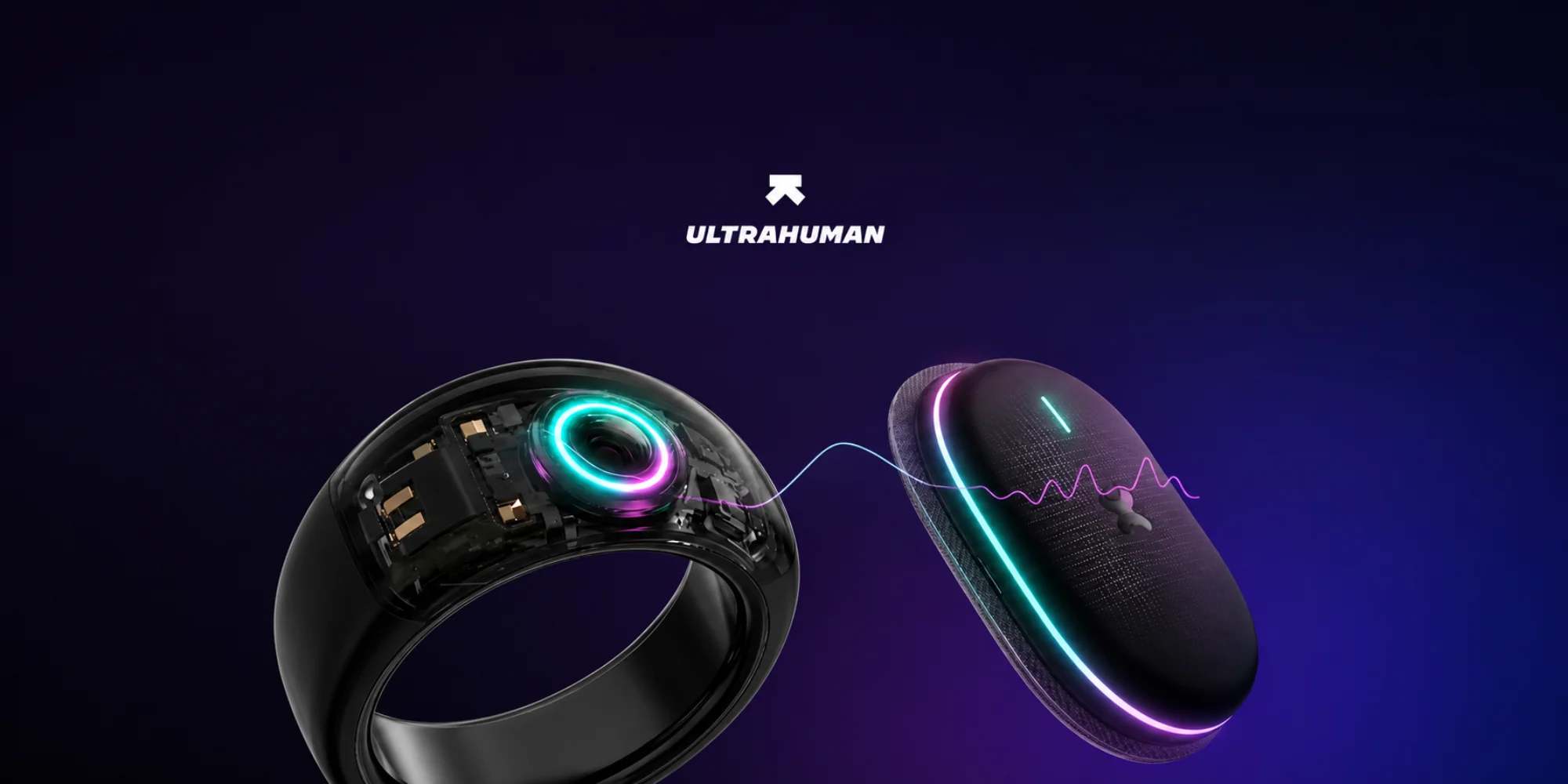
Ultrahuman’s Ring AIR is a lightweight titanium smart ring that continuously tracks key health metrics, including heart rate, heart rate variability (HRV), sleep stages, skin temperature, and movement. Unlike many competitors, it provides access to core health insights without a monthly subscription.
In early 2026, Ultrahuman introduced the Ring Pro, its third-generation smart ring. The device offers up to 15 days of battery life—significantly more than the Ring AIR’s 4–6 days—and is priced between USD 349 and USD 479.
The rings focus on metrics that help users understand recovery and overall wellness:
- HRV: Indicates how well the body is recovering from stress, illness, or poor sleep.
- Sleep Staging: Tracks light, deep, and REM sleep for a more complete view of sleep quality.
- Skin Temperature: Helps identify early signs of illness, hormonal changes, or metabolic stress.
- Recovery Score: Combines multiple signals into a daily readiness assessment.
2. The M1 Continuous Glucose Monitor
The M1 is a wearable sensor worn on the upper arm for up to 14 days. It tracks glucose levels in real time and syncs with the Ultrahuman app, where glucose data is analyzed alongside sleep, activity, and recovery metrics. Ultrahuman helped popularize Ultrahuman glucose monitoring among wellness-focused consumers looking to better understand how food, stress, exercise, and sleep affect their metabolism.
While continuous glucose monitors were originally designed for diabetes management, Ultrahuman helped popularize the technology among wellness-focused consumers looking to better understand how food, stress, exercise, and sleep affect their metabolism.
3. The Analytics Platform
Ultrahuman’s app brings together data from its smart rings and glucose monitor to generate actionable health insights. Instead of presenting isolated metrics, it highlights patterns between sleep, stress, recovery, activity, and metabolic health.
The platform also offers optional Power Plug features, including:
- AFib detection
- Ovulation and menstrual cycle tracking
- Snoring and respiratory analysis
- Migraine pattern insights
- Monitoring support for users taking GLP-1 medications such as Ozempic and Wegovy
Together, these products position Ultrahuman as a health intelligence platform rather than just a wearable device company.
How Ultrahuman Data Actually Works
The difference between a fitness tracker and a health intelligence platform lies in what happens after the data is collected. Traditional wearables typically track activity metrics such as steps taken, calories burned, and distance covered. While these numbers show what you did, they provide limited insight into how your body responded to those activities or how well it is recovering afterward.
Ultrahuman takes a different approach by focusing on physiological signals rather than activity alone. Through devices like the Ring AIR and M1 Continuous Glucose Monitor, the platform continuously gathers data about your body’s internal state and turns it into actionable personalized health insights.
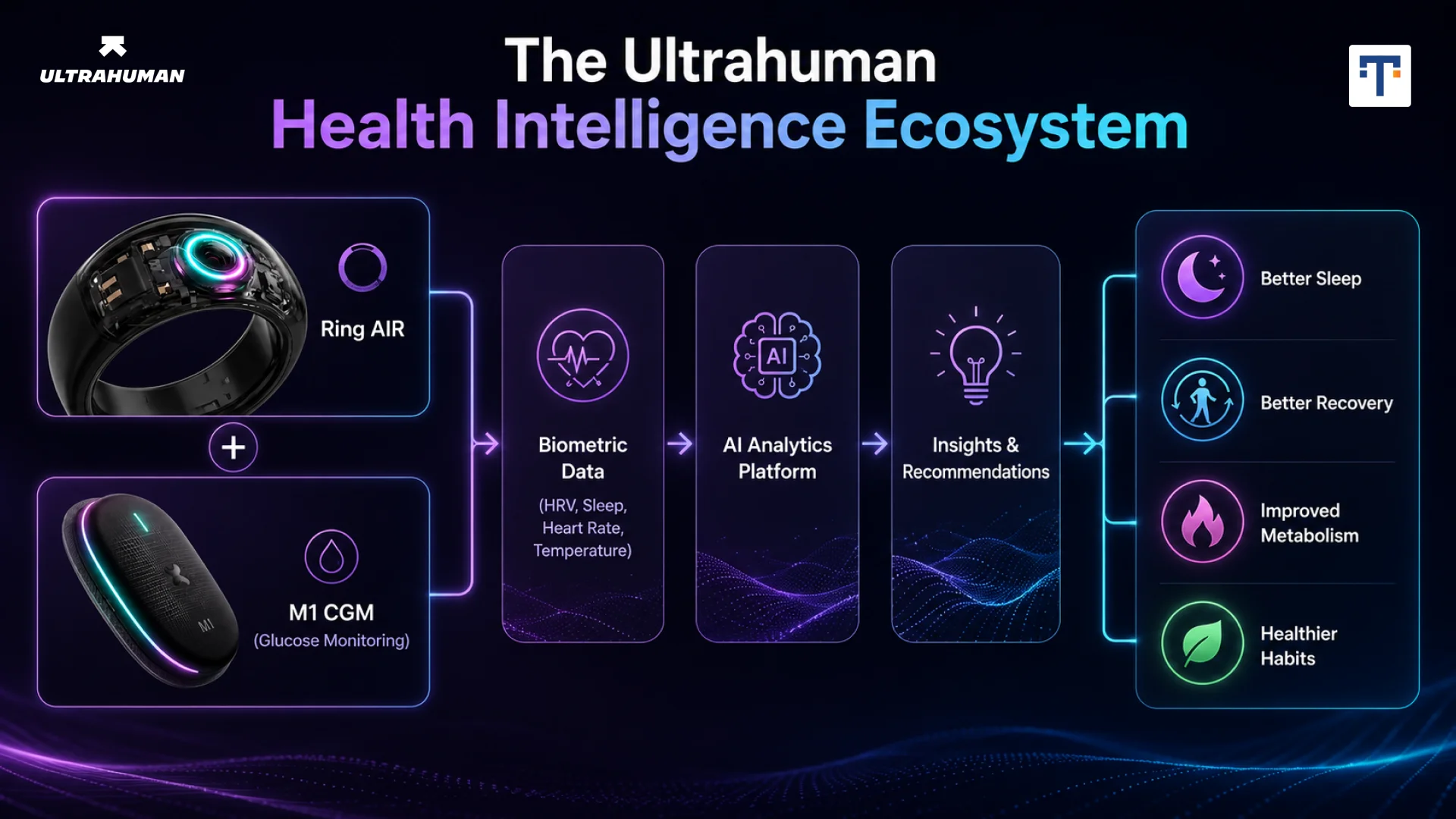
How It Works
Step 1: Collect Biometric Data
- The Ring AIR tracks heart rate, HRV, sleep quality, skin temperature, and movement.
- The M1 CGM monitors glucose levels in real time throughout the day.
Step 2: Analyze Body Responses
- The platform evaluates how factors such as sleep, meals, exercise, and stress affect your body’s performance and recovery.
- Instead of focusing on a single metric, it looks for patterns across multiple health signals.
Step 3: Connect the Signals
- Poor sleep can lead to lower HRV and slower recovery.
- Stress can affect both recovery and glucose stability.
- Meal timing and food choices can influence energy levels and metabolic health.
Step 4: Deliver Personalized Insights
- The app converts raw data into recovery scores, metabolic insights, and health recommendations.
- Users can identify habits that improve or negatively impact their well-being and make informed lifestyle adjustments.
What makes Ultrahuman unique is its ability to connect these data points into a unified health picture. Rather than presenting isolated metrics, the platform helps users understand the relationships between sleep, stress, recovery, activity, and metabolism, enabling more personalized health decisions.
The Business Model: How Ultrahuman Makes Money
Understanding the Ultrahuman business model is key to seeing why the company stands out. Its commercial structure is built around a hardware entry point that leads into a platform relationship. The ring and CGM generate direct revenue through hardware sales. Long-term value is built through continued engagement with the analytics platform.
Revenue streams:
- Hardware sales: Ring AIR, Ring Pro, and M1 CGM sensors (no mandatory subscription)
- Power Plug subscriptions: optional clinical features at an additional monthly cost
- Blood Vision: a laboratory biomarker testing service that correlates blood test results with continuous wearable data
- Ultrahuman Home: an ambient environment monitor measuring air quality, light exposure, and noise within residential spaces
The no-subscription model for core features is a deliberate commercial choice. It makes the Ring AIR and Ring Pro eligible for Health Savings Account (HSA) and Flexible Spending Account (FSA) purchases in the United States, which meaningfully expands the addressable buyer base and reduces the effective cost for many consumers.
Financially, the results are notable for a hardware-led business. Ultrahuman reported approximately $64 million in FY2025 revenue, a 5.4x increase from $12 million in FY2024. The company’s valuation reflects investor confidence in its model, and it has also achieved company-level profitability—an uncommon milestone for growth-stage consumer hardware companies.
Why This Matters Beyond the Gym
It would be easy to file Ultrahuman under “fitness tech” and move on. That would be a mistake.
The health challenges driving the greatest burden on global healthcare systems — metabolic disorders, cardiovascular disease, type 2 diabetes, chronic stress, sleep deprivation — are not acute events that strike without warning. They are the slow accumulation of lifestyle patterns that play out over years, often invisibly, before they cross the threshold into clinical significance. Wearable health technology like Ultrahuman’s is increasingly filling the gap that conventional medicine leaves open.
Continuous biomarker monitoring doesn’t replace clinical care. Ultrahuman is not a diagnostic tool and doesn’t claim to be. But it does something that annual bloodwork and occasional doctor’s visits fundamentally cannot: it provides a real-time, continuous signal of how the body is responding to everyday life. Sleep. Meals. Movement. Stress. These are the inputs that determine long-term health outcomes, and they are exactly what conventional healthcare has the least visibility into.
Wearables like Ultrahuman’s are increasingly functioning as behavioral coaching tools, devices that don’t just record data but actively shape decisions. When a user can see how a late-night meal affects their sleep quality and glucose stability the following morning, or how three consecutive nights of poor sleep suppresses their HRV and cognitive performance, the feedback loop becomes motivating in a way that abstract health advice rarely is. The data makes the consequences of behavior visible in real time.
What Ultrahuman’s Trajectory Tells Us
In less than five years, Ultrahuman has evolved from a Bengaluru-based startup into one of the world’s leading smart ring companies. Despite facing a patent dispute and temporary exclusion from the U.S. market, the company has continued to grow while maintaining profitability—a rare achievement in the wearable technology industry. Its success demonstrates that an Indian-founded health-tech company can compete globally against well-funded international players.
More importantly, Ultrahuman reflects a broader shift in healthcare toward continuous monitoring and preventive wellness. The Ultrahuman business model combining wearable devices, metabolic tracking, and personalized insights without a mandatory subscription — is helping users better understand their health in real time. As continuous biometric health monitoring becomes more mainstream, Ultrahuman’s growth suggests that data-driven, preventive healthcare is moving closer to the center of modern wellness and healthcare systems.

Tech Insights Digest
Sign up to receive our newsletter featuring the latest tech trends, in-depth articles, and exclusive insights. Stay ahead of the curve!